

Ulugh Beg Observatory
The remains of the 15th-century observatory where Ulugh Beg compiled his star catalogue: the underground arc of a giant sextant and a museum.
About this place
The Ulugh Beg Observatory is where one of the most advanced scientific schools of its time worked in the 15th century. Mirzo Ulugh Beg, ruler of Samarkand and grandson of Timur, was above all a scholar. The observations he and his colleagues made here still impress with their accuracy.
History of the observatory
The observatory was built on Kuhak hill in the 1420s. It was a round three-storey building housing a huge instrument — the Fakhri sextant, with an arc about 40 metres in radius.
How the sextant worked
The arc of the instrument was laid out precisely along the meridian. Astronomers noted the point on the arc where the Sun, the Moon and the stars crossed the meridian, and from these observations they calculated their coordinates. The sheer size gave an accuracy that small instruments could not match.
In 1449 Ulugh Beg was killed in a plot led by his own son, Abd al-Latif. Soon afterwards the observatory was destroyed and long forgotten. In 1908 the archaeologist Vasily Vyatkin located its remains with the help of an old document. Excavations uncovered the underground part of the sextant’s arc — the part visitors see today.
Scientific legacy
- The Zij-i Sultani — Ulugh Beg’s astronomical tables, with a catalogue describing 1,018 stars.
- The length of the sidereal year was calculated here with an error of less than a minute.
- Recognition in Europe. In the 17th century Ulugh Beg’s tables were translated into Latin and studied at European universities.
What to see
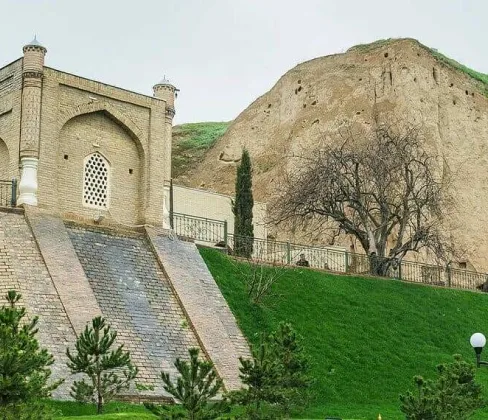
- The underground section of the sextant’s arc — a stone-lined trench cutting deep into the hill.
- The museum next door: a model of the observatory, copies of manuscripts and the story of Ulugh Beg’s life.
- A view over the city from the top of the hill.
Practical tips
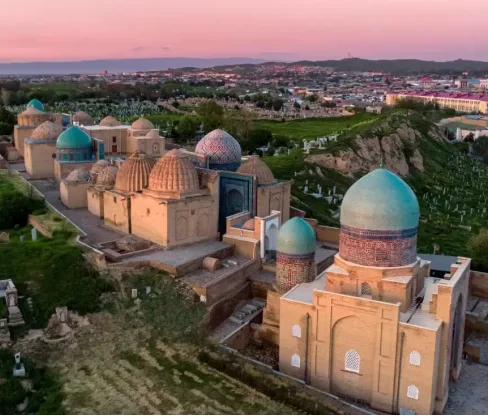
A visit takes 45–60 minutes. The hill is exposed to the sun, so in summer come in the morning or towards evening and bring water. The observatory is away from the centre, about 2 km from Shah-i-Zinda — the bus is a better option than walking between them.
One man’s story along the route
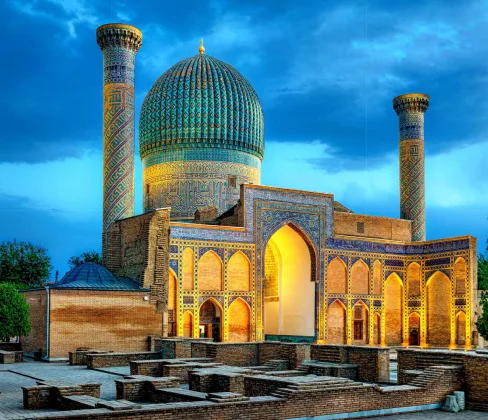
The route begins at Ulugh Beg’s grave in Gur-Emir, passes his madrasah on Registan and brings you here, to his observatory. By the end of the day the story of the scholar-king comes together as a whole.
 Buy a ticket for the route